





















Most owners searching for walnut blasting are really asking a bigger question: why does a modern European engine with good maintenance start to idle rough, misfire or feel flat as the miles build? On many direct-injection engines, the answer is carbon baked onto the back of the intake valves. Walnut blasting is the most common way to remove it.
Walnut blasting is a cleaning process. A technician removes the intake manifold, closes the valves on one cylinder at a time, and blasts finely crushed walnut shells into the port with compressed air. A vacuum pulls the loosened carbon and spent media back out. The shells are hard enough to break up carbon but softer than the valve and seat, so the metal underneath is not harmed. It restores airflow. It does not change the design that caused the buildup, so the carbon will come back over time.
Why Direct-Injection Engines Build Carbon on Their Intake Valves
For decades, gasoline engines used port fuel injection. The injector sprayed fuel into the intake port, right onto the back of the intake valve. Gasoline is a solvent, and modern fuel carries detergents, so every intake stroke washed the valve.
Gasoline direct injection (GDI) moved the injector into the combustion chamber. Fuel now enters after the air, at very high pressure, which improves efficiency and power. The tradeoff is that fuel never touches the intake valve again. Anything that lands on the hot valve stays there.
What lands there is mostly oil. A 2016 SAE paper by researchers at Afton Chemical found that GDI intake valve deposits form from a mix of engine oil, engine wear elements, unburned fuel and exhaust contaminants. The same work found that engine oil formulation changed how fast deposits built up.
The oil arrives by two routes. Crankcase ventilation (the PCV system) sends oily blow-by vapor back into the intake to be burned. Small amounts of oil also seep past the valve stem seals in normal operation. On a valve that runs hot, that film bakes into hard carbon, layer by layer.
Exhaust gas recirculation can add soot to the mix. Over tens of thousands of miles, the deposits grow thick enough to disturb airflow into the cylinder.
Which European Engines Are Prone to Carbon Buildup
Any engine that relies on direct injection alone is a candidate. That covers a large share of European gasoline engines built since the late 2000s.
BMW. The twin-turbo N54 inline-six is the clearest documented case. BMW addressed it in its own service bulletin, SI B12 02 12 (October 2014). It says N54 drivability complaints and misfires “may be attributed to the formation of intake valve and port carbon deposits”. The fix it prescribes is removing the intake manifold and cleaning the valves with BMW’s carbon blaster tool and walnut shell media. Later direct-injection BMW engines such as the N20, N55 and B58 use the same basic fuel layout, so the valves on high-mileage examples are worth inspecting when symptoms appear.
Audi and Volkswagen. The 2.0 TFSI and TSI engines, along with other FSI and TFSI designs, rely on direct injection. Audi carbon cleaning on these engines is one of the most discussed topics among owners. Audi’s training material for the third-generation EA888 engine describes a dual system that adds port injectors to cut particulate emissions. It also notes that dual injection was not used when the engine was introduced in North America. Model year and market matter, so check the engine code before assuming.
Mercedes-Benz. Mercedes introduced direct injection on several 2012 model-year engines, including a 1.8L turbocharged four and a new 3.5L V6. These engines are not immune to intake deposits either.
Mini. Turbocharged Mini Cooper S engines of the same era also use direct injection and share the same basic exposure.
The problem is not limited to European brands. Subaru published a walnut blast cleaning bulletin, TSB 02-193-24R, for several of its engines. It names “fuel quality and how the vehicle is operated” as major factors in how fast carbon builds.
Symptoms That Point to Carbon on the Intake Valves
Carbon buildup is gradual, so the symptoms creep in. The common signs are:
- Rough or uneven idle, especially right after a cold start
- Misfire codes (P0300 to P0306 and similar) or a flashing check engine light
- Hesitation or stumbling under light acceleration
- A gradual loss of power and throttle response
- Slightly worse fuel economy
Cold-start misfires are a classic pattern. Thick deposits disturb the air’s path into the cylinder, and the engine is most sensitive to that before it warms up.
None of these symptoms prove carbon is the cause. A failing ignition coil, a worn spark plug, a leaking injector, a vacuum leak or a failed crankcase vent valve can all produce the same complaint. That is why BMW’s bulletin tells technicians to run the misfire test plan first. Cleaning follows only when the fault pattern points to “coking in the intake ports”. Our diagnostics and check engine light service follows the same logic: confirm the cause, then fix it.
What Walnut Blasting Involves, Step by Step
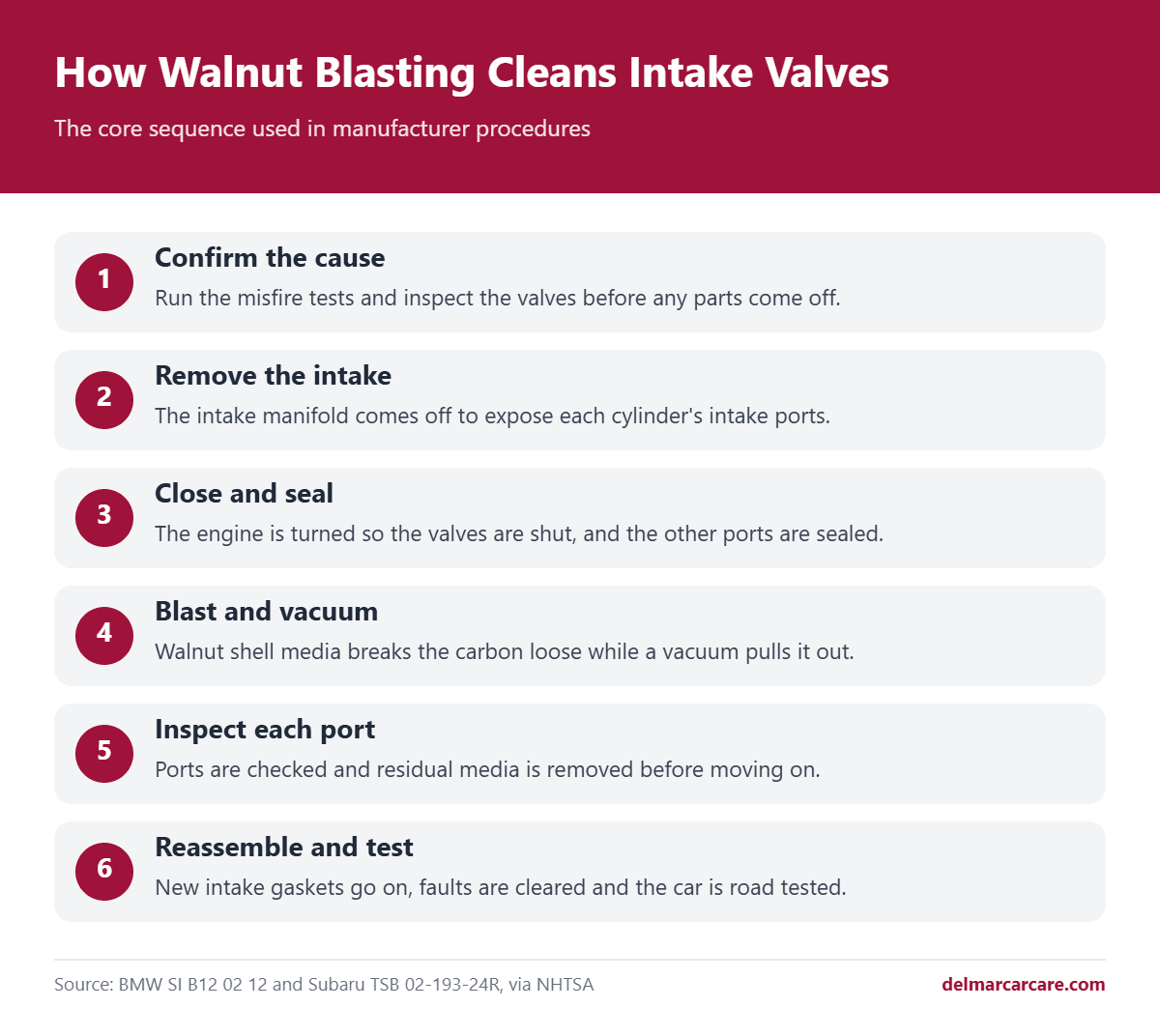
The manufacturer procedures from BMW and Subaru follow the same sequence. Details vary by engine, but the job looks like this:
- Confirm the diagnosis with fault data, misfire counters and a look at the valves.
- Remove the intake manifold and any parts in the way, such as a strut brace or fuel lines.
- Turn the crankshaft until the intake valves on the target cylinder are fully closed.
- Seal the ports that are not being cleaned so no media can wander.
- Blast walnut shell media through a nozzle while a vacuum pulls out the carbon and spent shells.
- Inspect the port, then remove any remaining media by hand and vacuum.
- Repeat for each cylinder, then refit the intake with new gaskets and clear the fault codes.
Closed valves matter. With the valve seated, the walnut media cannot fall into the cylinder. Careful cleanup matters too, because loose shell fragments left in a port will be drawn in when the engine starts. Subaru’s bulletin specifies new media for every job and warns technicians not to scratch the valves or cylinder head.
Walnut shells are used because of their hardness. They are aggressive on carbon but gentle on steel valves and seats. Harder media, such as sand or glass bead, would damage the valve faces and could cause serious harm if any got past the seal.
Because the intake is off anyway, it is a sensible time to inspect vacuum lines and the crankcase ventilation parts.
Walnut Blasting vs Chemical Carbon Cleaning
Walnut blasting is not the only way to clean intake valves. The real choice depends on how thick the deposits are and how much access the job allows.
| Method | How it works | Intake removed? | Best suited to | Main limit |
|---|---|---|---|---|
| Fuel tank additive | Detergent mixed into gasoline | No | Injector and chamber deposits | Fuel never reaches GDI intake valves |
| Induction spray cleaner | Solvent fed into the running engine’s intake | No | Light, early deposits | Struggles with thick, hard carbon |
| Soak and scrape | Solvent applied to closed valves, then scraped and vacuumed | Yes | Moderate deposits | Slow, labor heavy |
| Walnut blasting | Crushed shell media blasted and vacuumed | Yes | Heavy, baked-on carbon | Labor cost of removing the intake |
| Head removal | Valves cleaned off the engine | Yes, plus head | Severe cases or other head work | Highest cost by far |
Fuel additives help keep injectors clean. On a direct-injection engine, though, the fuel never touches the intake valves, so a bottle in the tank cannot clean them. Subaru’s bulletin adds a fuel cleaner after blasting, but that targets injectors and combustion chambers.
Induction spray cleaners can help when deposits are light. On the hard, thick carbon that causes misfires, mechanical cleaning is usually the more reliable fix.
What Walnut Blasting Costs and What Drives the Price
Most of the cost of walnut blasting is labor. The intake manifold has to come off and go back on, and each cylinder is cleaned in turn. The walnut media itself is cheap. Subaru’s bulletin allows up to $2.00 of sublet for it.
For a sense of scale, Subaru allows 3.0 hours of warranty labor for diagnosis and media cleaning on its naturally aspirated engines, and 3.6 hours on turbocharged versions. Those figures apply to a four-cylinder Subaru, not a BMW inline-six or an Audi V6. They do show that this is a multi-hour job.
As a third-party reference, Consumer Reports reported in 2020 that one shop it spoke with quoted about $1,000. That is a single quote from one shop several years ago. It is not Del Mar Car Care’s price, and actual cost varies widely with the engine.
The main factors that move the price are:
- Engine layout: an inline-four is quicker than a V6 or V8 with two banks
- Packaging: how much must come off to reach the intake
- Deposit severity: thick carbon takes more passes per port
- Related parts: intake gaskets, PCV parts or plugs found worn along the way
If you want a number for your car, ask us. We can assess the engine and the symptoms, confirm whether carbon is the cause, and quote the work for your specific model.
Is Walnut Blasting Worth It?
When carbon is the confirmed cause of misfires or a rough idle, the answer is usually yes. The alternative is living with poor drivability, or a far more expensive cylinder head job later. A clean intake also removes one variable when chasing other faults.
It is not worth doing as a blind fix. If the car runs well and has no codes, there is no factory rule saying it needs cleaning at a set mileage. Spending money on walnut blasting to cure a misfire that turns out to be a coil is the outcome to avoid.
It also helps to be realistic about how long it lasts. As one engine rebuilding expert told Consumer Reports, “there is no long-term fix.” The deposits return at a rate set by the engine design, the oil and the way the car is driven. Many owners treat cleaning as periodic maintenance on high-mileage direct-injection engines.
Timing helps with value. If the intake is coming off for other engine work, adding a cleaning saves most of the access labor. Our engine repair service can plan for that.
How to Slow Carbon Buildup on a Direct-Injection Engine
You cannot stop carbon from forming on a GDI engine. You can slow it down.
Use the right oil and change it on time. The Afton research found that oil formulation affects how fast valve deposits accumulate. Use an oil that carries your manufacturer’s approval, such as a BMW Longlife or VW 504/508 specification, and do not stretch the interval. Our guide to routine oil changes explains why fresh oil matters on turbocharged engines.
Keep the crankcase ventilation healthy. A failed PCV or crankcase vent valve can pull extra oil into the intake. On many European engines that valve is built into the valve cover. Fixing it early protects the intake valves.
Mix in longer drives. Engines that only ever see short trips run cooler and collect more fuel and moisture in the oil. A regular highway drive at operating temperature helps.
Fix misfires and oil consumption promptly. Worn valve stem seals or piston rings send more oil toward the valves. Rising oil use is a signal worth acting on.
Some owners fit an aftermarket oil catch can to trap oil before it reaches the intake. In California, any add-on part that changes an emissions system needs a CARB Executive Order to be legal for street use. Check that status before installing one.
How Carbon Cleaning Fits Into Long-Term Ownership
Walnut blasting is one line item in the cost of owning a direct-injection European car. Our breakdowns of BMW maintenance cost and Audi maintenance cost show where it fits among the other systems that need attention. If you are shopping for a used one, ask whether the intake valves have ever been cleaned.
Frequently Asked Questions
What is walnut blasting?
Walnut blasting is a method of cleaning carbon deposits from the intake valves and ports of a direct-injection engine. Finely crushed walnut shells are blown into each port with compressed air while a vacuum removes the loosened carbon. The intake manifold must be removed to do it.
How do I know if my engine needs walnut blasting?
Rough idle, cold-start misfires, hesitation and lost power are the usual signs. Because ignition, injector and vacuum faults cause the same symptoms, a proper diagnosis should confirm carbon before any cleaning is booked.
How often should intake valves be cleaned?
There is no universal factory interval. It depends on the engine, the oil and how the car is driven. Many owners of high-mileage direct-injection engines have the valves inspected whenever symptoms appear or the intake is off for other work.
Can walnut blasting damage the engine?
Done correctly, with the valves closed, other ports sealed and all media removed, the risk is low. Walnut shells are softer than the valve and seat. The main risk comes from leftover media that is not cleaned out before the engine is restarted.
Will a fuel additive clean my intake valves?
Not on a direct-injection-only engine. The fuel sprays straight into the cylinder and never touches the intake valves. Additives can help keep injectors clean, but they cannot reach the valve deposits.
Do newer engines still need carbon cleaning?
Engines with both port and direct injection spray fuel onto the valves part of the time, which reduces buildup. Many recent designs use this layout, but not all, so check whether your specific engine has port injectors.
The Cost of Waiting
Carbon buildup does not usually cause sudden failure. It does make an engine progressively rougher and less efficient. Misfires left unchecked can also overheat the catalytic converter, turning a cleaning job into a much larger repair.
The Short Version
Walnut blasting removes the carbon that direct injection allows to bake onto intake valves. It works well when carbon is the confirmed cause, and it should follow a real diagnosis, not a hunch. If your direct-injection BMW, Audi, VW, Mini or Mercedes idles rough or throws misfire codes, book an appointment and we will find the cause and give you a clear quote before any work begins.