






















Most owners asking about Airmatic want to know two things. Which part has failed, and does the whole system need replacing? A car that sits low in the morning or shows an Airmatic warning has a problem somewhere in a system of air springs, a compressor, valves and sensors. Good Mercedes Airmatic suspension repair starts by finding which one.
Many Airmatic failures begin with a leak. Rubber air springs age, crack and lose pressure. The compressor then runs longer and more often to keep up, and it can wear out as a result. Replacing the compressor without fixing the leak usually means buying a second compressor. The right repair might be a single strut, a relay, a valve block or a sensor, and a proper diagnosis tells you which.
How Mercedes Airmatic Suspension Works
Airmatic is Mercedes-Benz’s air suspension with adaptive damping. Instead of steel coil springs, each corner of the car rides on a rubber air bladder filled with compressed air. Changing the pressure in each bladder changes the ride height at that corner.
The main parts are:
- Air struts or air springs at each wheel, usually combined with an electronically adjustable shock absorber
- A compressor that pumps air into the system
- A valve block with solenoid valves that send air to, or release air from, each corner
- A reservoir that stores pressurized air for quick adjustments on many models
- Level sensors that report ride height to the control unit
- A control unit and relay that decide when the compressor runs
The damping side matters as much as the air side. Mercedes paired the air springs with an adaptive damping system that firms up or softens the shocks to suit the road, the load and the driving style. On the W220 S-Class, where Airmatic was standard equipment, the car also lowered itself by 15 mm above 140 km/h (about 87 mph) to improve stability.
Airmatic is not the same as Active Body Control (ABC). ABC is a hydraulic system with a high-pressure pump and hydraulic struts, offered on some S-Class and CL models. The diagnosis, parts and costs are completely different, so it helps to know which one your car has before getting quotes.
Which Mercedes Models Have Airmatic Suspension?
Airmatic first appeared on the W220 S-Class in the late 1990s. Since then it has been fitted, as standard or as an option, to many larger Mercedes models. Common examples include:
- S-Class (W220, W221 and later generations)
- CL-Class coupes
- CLS (W219 and later)
- E-Class (some trims and generations)
- ML and GLE SUVs (optional on many versions)
- GL and GLS SUVs
- R-Class
Fitment varies by year, trim and market, and some cars have air suspension at the rear only. If you are not sure, the vehicle’s build data will tell us. An Airmatic car will also show Airmatic-specific warnings when something goes wrong.
Signs Your Airmatic Suspension Needs Repair
Airmatic problems usually show up in a few recognizable ways:
- Overnight sag. One corner, one axle or the whole car sits low after parking, then rises once started.
- A compressor that runs too long or too often. You may hear it working at idle or after short stops.
- Dashboard warnings. “AIRMATIC Visit Workshop” usually signals a system fault. “AIRMATIC Stop, Car Too Low” is more serious and may mean the car should not be driven.
- Hissing near a wheel. An audible leak at a strut top or fitting.
- A harsh, floaty or bouncy ride. This can point to a failed damper inside the strut rather than an air leak.
- Uneven ride height. The car leans to one side or sits nose down.
These symptoms overlap with other suspension issues. Our guide to recognizing suspension and steering problems covers the wider picture, including worn bushings and steering components.
What Fails in an Airmatic System, and Why
Air springs and struts. The rubber bladder is a very common failure point. Arnott, a major maker of replacement air suspension parts, explains that the rubber sleeve dries out over time and cracks form. It puts typical replacement at 6 to 10 years or 80,000 to 100,000 miles. Strut top seals and brass fittings can also leak.
The compressor. Compressors wear out, and the usual reason is that they have been working too hard. Arnott states that “compressors usually wear out because of leaky air springs.” Every leak forces the compressor to run longer and hotter, and eventually it can no longer build pressure in time.
The relay. The compressor relay switches heavy current. If its contacts stick, the compressor can run continuously and overheat. The MB Medic troubleshooting guide lists a stuck relay as a cause of compressor damage on the W220.
The valve block. Its solenoid valves control air to each corner. A leaking valve can let one corner drop or bleed air back toward the compressor.
Level sensors. These report ride height. A faulty sensor or a damaged linkage can trigger warnings or wrong ride height even when the air system is sound.
Air lines. Plastic lines can crack or chafe, especially near heat sources or where they are clipped to the body.
Matching the Symptom to the Likely Cause
The table below shows how common symptoms usually line up with failed parts. It is a starting point for diagnosis, not a substitute for testing.
| Symptom | Most likely cause | Also check |
|---|---|---|
| One corner low after sitting | Leaking air spring or strut | Valve block, line or fitting at that corner |
| Whole car low after sitting | Leak at a shared point, or compressor fault | Reservoir, valve block, relay |
| Compressor runs constantly | Leak, or a stuck relay | Weak compressor, pressure sensor |
| Compressor never runs | Blown fuse or failed relay | Compressor motor, wiring |
| Warning but height looks normal | Level sensor or electrical fault | Damper valve wiring, control unit |
| Bouncy or harsh ride | Failed damper in the strut | Damping valve faults stored in the module |
How We Approach Airmatic Diagnosis
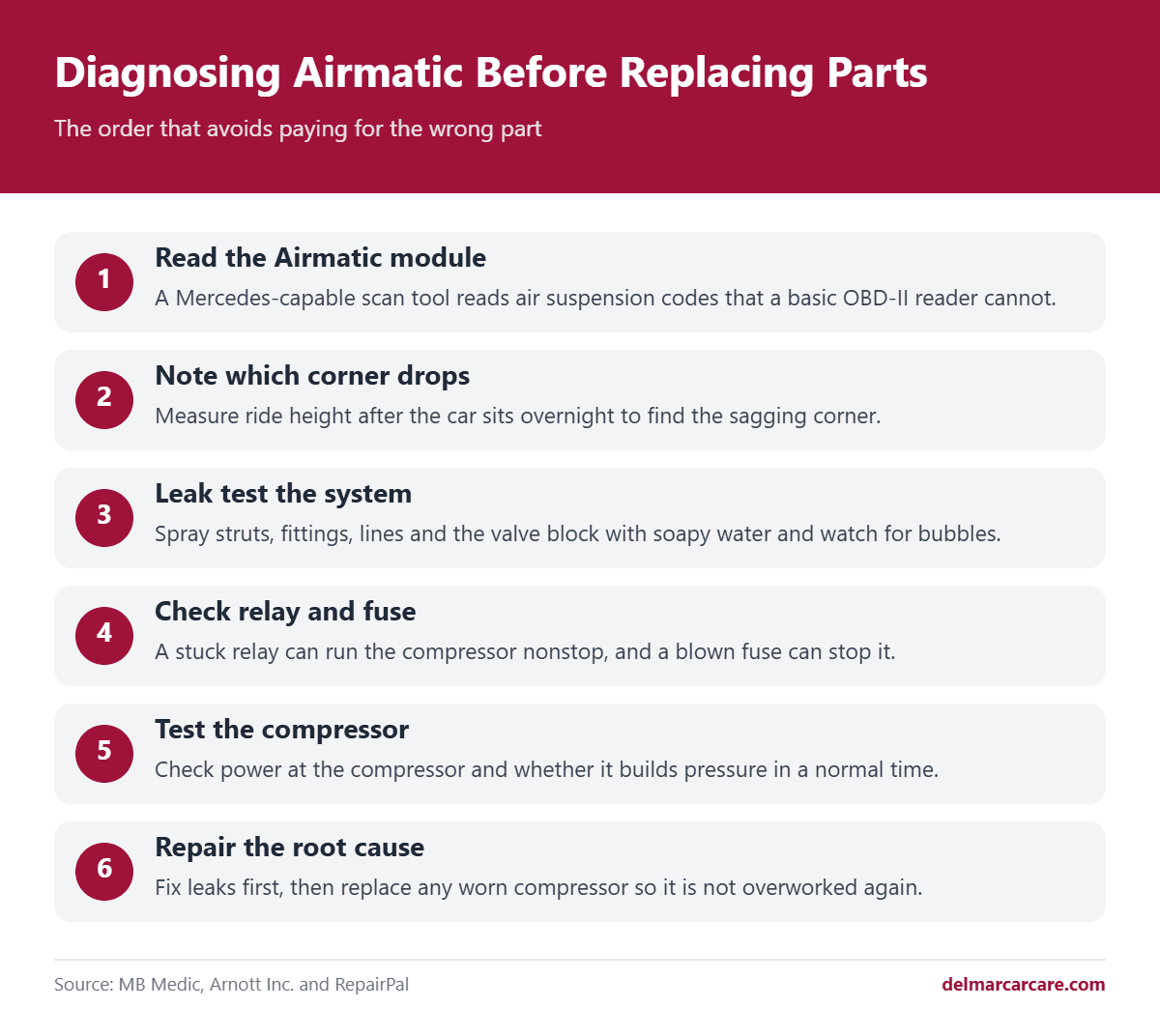
Good Mercedes Airmatic suspension repair begins with the control unit, not the parts catalog. A generic OBD-II code reader cannot see the air suspension module. A Mercedes-capable scan tool can read Airmatic fault codes, show live ride height and pressure values, and run the compressor and valves on command. Our diagnostics service uses that kind of testing to narrow the fault before parts are ordered.
Next comes the leak search. Soapy water sprayed on strut tops, fittings, lines and the valve block will bubble at a leak. Measuring the height at each corner after the car sits overnight shows which side is losing air. Electrical checks then confirm whether the relay, fuse and compressor are doing their jobs.
There is one safety point for anyone working on these cars. The air suspension should be disabled following the factory procedure before the car is raised. RepairPal notes the system may try to level itself while the car is in the air.
Repair vs Replace: Choosing the Right Fix
Once the failed part is known, there are usually several ways to approach Mercedes Airmatic suspension repair.
Replace only the failed strut, or the pair. Arnott recommends replacing air springs in pairs, since both sides have usually seen the same wear. That is a recommendation, not a rule, for most models. Replacing one side can make sense on a car with low mileage or a recent replacement on the other side.
Genuine, original-equipment or remanufactured parts. Genuine Mercedes struts cost the most. Remanufactured and new aftermarket struts from established makers cost less and often carry their own warranty. Quality varies, so the brand and warranty terms matter.
Fix the leak before replacing the compressor. If a strut has been leaking for months, the compressor may already be worn. Replacing the compressor alone leaves the leak to wear out the new one. Replacing the strut alone may leave a weak compressor that fails soon after. The right answer depends on how the compressor tests.
Replace the relay with the compressor. A relay is inexpensive. Since a stuck relay can destroy a compressor, many technicians replace it whenever the compressor is replaced.
Our suspension and steering service covers this work, and we will explain the options and the tradeoffs before any parts are ordered.
Coil Spring Conversion Kits: The Tradeoffs
Some owners of older Mercedes models consider replacing Airmatic with conventional coil springs. Conversion kits exist for many Airmatic cars. Many include an electronic module to switch off the suspension warning lights.
The appeal is clear. A conversion removes the compressor, air springs and valve block from future repair bills. It can make sense on an older, high-mileage car where the next air suspension repair would cost a large share of the car’s value.
The tradeoffs are real, though:
- No automatic leveling. Arnott notes that coil springs cannot match air suspension for towing or carrying heavy loads.
- No ride height adjustment. The raise function for steep driveways or rough roads is gone.
- Different ride and handling. The car was engineered around air springs and adaptive damping, and a conversion changes how it rides.
- Resale. Some buyers of luxury cars prefer an original suspension.
If you plan to keep the car for years and value the ride it was designed with, repairing Airmatic is usually the better choice. If the car is near the end of its economic life, a conversion can be reasonable.
Mercedes Airmatic Suspension Repair Cost
Mercedes air suspension repair cost depends on which part failed and how many corners need work. The figures below are third-party estimates from RepairPal, accessed in October 2026. They are not Del Mar Car Care’s prices. They cover single repairs and do not say how many parts each estimate includes.
| Repair and model | Model years | RepairPal estimate |
|---|---|---|
| Air spring, ML350 | 2006 to 2011 | $848 to $905 |
| Air spring, ML350 | 2012 to 2015 | $970 to $1,084 |
| Air spring, GL450 | 2007 to 2012 | $891 to $971 |
| Air spring, GL450 | 2013 to 2016 | $970 to $1,154 |
| Air compressor, ML350 | 2012 to 2015 | $1,034 to $1,148 |
| Air compressor, S550 | 2016 to 2017 | $1,361 to $1,441 |
Real repair bills can be higher. A car that needs a strut and a compressor pays for both. Front struts on large sedans, multiple failed corners and genuine parts all push costs up. For context on where suspension work fits in the overall picture, see our guide to Mercedes maintenance cost.
Can You Drive With an Airmatic Fault?
It depends on the warning. With a “Visit Workshop” message and normal ride height, the car is usually drivable to a shop with care. A slow leak that only shows after a night parked can often wait a short time for an appointment.
“Car Too Low” is different. Driving a car that sits on its bump stops can damage tires, the underbody and suspension parts, and it can make handling unsafe. In that case, a tow is often the safer choice.
Do not let a slow leak run for months. Every day the compressor works overtime, it wears toward failure, turning a strut repair into a strut and compressor repair. Our article on the hidden cost of delaying Mercedes maintenance explains how that kind of chain reaction drives up ownership costs.
Frequently Asked Questions
How much does Mercedes Airmatic suspension repair cost?
It depends on which part failed. Third-party RepairPal estimates run from roughly $850 to $1,150 for an air spring replacement on an ML350 or GL450, and about $1,000 to $1,450 for a compressor on some models. Multiple failed parts or genuine struts cost more.
Why does my Mercedes sag overnight?
Overnight sag almost always means air is escaping. The most common cause is a cracked air spring or a leaking strut top seal, followed by leaking valve blocks, lines or fittings.
Should I replace both Airmatic struts at once?
Arnott recommends replacing air springs in pairs because both sides usually have the same wear. It is not required on most models, so a single replacement can make sense if the other side is newer.
What does “Airmatic Visit Workshop” mean?
It means the Airmatic control unit has detected a fault, often electrical or a pressure problem. The car may still drive normally, but the system should be scanned with a Mercedes-capable tool soon to find the cause.
Is Airmatic the same as Active Body Control?
No. Airmatic uses air springs and a compressor. Active Body Control is a hydraulic system with a high-pressure pump and hydraulic struts. They use different parts and have different repair costs.
Is a coil spring conversion a good idea?
It can be on an older, high-mileage car where air suspension repairs would cost a large share of its value. You give up automatic leveling, adjustable ride height and some of the original ride quality.
How long does Airmatic suspension last?
Arnott puts typical air spring life at 6 to 10 years or 80,000 to 100,000 miles. Climate, mileage, rough roads and whether leaks are fixed promptly all affect how long the rest of the system lasts.
The Cost of Waiting
A small Airmatic leak is the cheapest version of this repair. Left alone, it wears out the compressor and can leave the car sitting on its bump stops. One failed part becomes two or three.
The Short Version
Mercedes Airmatic suspension repair comes down to finding the real failure, fixing the leak at its source, and protecting the compressor. Diagnose first, replace only what has failed, and choose parts with a good warranty. If your Mercedes sags, hisses or shows an Airmatic warning, book an appointment and we will test the system and give you a clear quote before any work begins.