





















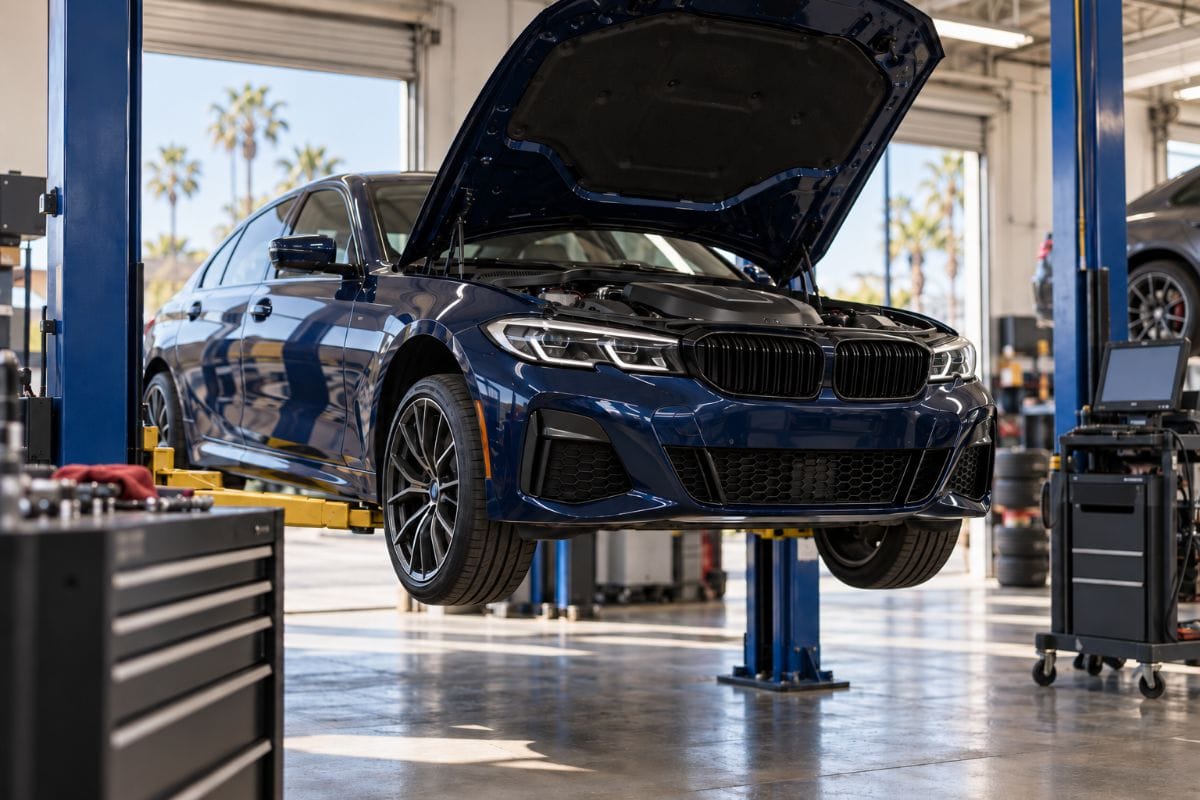
Ask most people whether a BMW is expensive to maintain and you will get an answer shaped by somebody else’s bad year. The reality is more predictable than the reputation, and the predictability is the useful part, because a cost you can anticipate is a cost you can plan around.
This article sets out what drives BMW maintenance cost, which systems account for most of the spend, how the pattern shifts as a car ages, and where owners most often lose money without needing to.
Why the Reputation Exists
Two things created it. The first is that BMW builds cars with more systems than a mainstream saloon, and every system is a thing that can eventually need attention. The second is that a large share of BMWs on the road are on their second or third owner, bought at a price that suggests mainstream running costs and maintained on a mainstream budget.
That mismatch produces the horror stories. The car did not become unreliable; it reached the age at which a complex car needs money, in the hands of someone who budgeted for a simpler one.
Our guide to what BMW owners should know before problems start covers the preventative side of this in detail. Cars maintained on schedule from new, by someone who understood what they were buying, produce very different ownership experiences. We see both in the workshop, and the difference is rarely the car.
BMW Maintenance Cost: Where the Money Goes
Across the BMWs we service, spending concentrates in a small number of places.
Cooling system. This is the single largest recurring theme on older BMWs. Water pumps, thermostats, expansion tanks and the plastic components around them have a service life, and they tend to reach it around the same mileage. The cost of replacing them is moderate. The cost of not replacing them is an overheating event, and that bill is in a different category entirely. We cover the principle in our guide to coolant and cooling system care.
Oil service and the systems around it. Oil changes themselves are routine. What raises the cost is what accompanies them on a modern BMW: filter housings and gaskets that weep, valve cover gaskets, and the oil separator components on certain engines.
Suspension and bushings. Ride quality on a BMW comes from components that wear. Control arm bushings, thrust arms and mounts degrade gradually, and because the change is gradual most owners do not notice until a steering or handling complaint appears.
Electronics and modules. Modern BMWs carry a lot of control units. Failures here are less frequent than the internet suggests, but diagnosis takes time and time is the cost.
Brakes and tyres. Consistently underestimated. Performance-oriented cars come with performance-oriented consumables, and both wear faster and cost more than the equivalents on a mainstream car.
What BMW Maintenance Cost Looks Like in Numbers
Brand averages are the figure everyone quotes and the least useful number in the conversation, so it is worth seeing one and then seeing why it misleads.
RepairPal puts BMW at around $968 a year in maintenance and repair, against roughly $652 a year across all makes and models. That is about half again as much as an average car, which is the statistic that gets repeated. It is also an average of a 330i and an X5, which are not the same ownership proposition.
The model spread tells you more. On the same data a 330i sits near $748 a year, an X3 near $1,034, an X5 near $1,166 and an M5 near $1,173. Choosing the car is most of the choosing of the budget.
Published fair-price ranges for individual jobs are the part worth planning around:
- Oil service, roughly $214 to $323 depending on model and oil specification.
- Tire rotation, roughly $77 to $113.
- Spark plugs, roughly $303 to $673, since cylinder count and access vary enormously.
- Coolant service, roughly $357 to $891.
- Brake pads and rotors, roughly $1,002 to $4,925.
That last range is the honest answer to what a BMW costs. It is not evasive: it spans one axle on a four-cylinder saloon and both axles with performance brakes on a large M car. An annual average conceals exactly that difference, which is why we would rather talk about the specific car in front of us.
On the figures in this article. These are published national averages and third-party fair-price ranges, included to give a sense of scale. They are not our prices and they are not a quote. What a particular car costs depends on the model, the year, its condition and service history, the region, and what an inspection actually finds. For a number you can plan around, ask us to quote your car.
How the Cost Curve Changes With Age
BMW maintenance cost is not a flat annual figure, and treating it as one is how owners get caught out.
The first years are cheap. Scheduled servicing, consumables, very little else. The curve then rises through the middle of the car’s life as the wear items described above come due, typically clustering rather than arriving one at a time.
Older cars settle into a different pattern again. By that point most of the age-related components have been addressed, and spending becomes less about predictable wear and more about whatever has not been touched yet.
The practical implication is that a low-mileage car with no service history is not the bargain it appears to be. Deferred work does not disappear. It waits.
What Separates a Cheap Year From an Expensive One
In our experience the difference comes down to four things.
- Whether small symptoms were investigated. A weep becomes a leak, a leak becomes a failure. The cheapest intervention is nearly always the earliest one.
- Whether the previous owner deferred. Service history is the single most informative document about future cost.
- Whether work is grouped sensibly. Several jobs in the same area of the car share labour. Doing them separately pays for the same access three times.
- Where the work is done. Dealer labour rates and parts pricing differ from an independent specialist’s, and on out-of-warranty cars the gap is substantial.
Reducing What You Spend
Nothing here is exotic, and all of it works.
Service on schedule rather than on symptom. Use the correct fluids and parts rather than the cheapest available, because on these engines the specification is not marketing. Address cooling system components preventively once the car reaches the age at which they fail, rather than waiting. Group work where access overlaps. And build a relationship with a shop that knows the platform, so that somebody has context on your specific car rather than meeting it cold each time.
The owners who spend least are not the ones who spend least per visit. They are the ones who never have the large unplanned bill.
Which BMWs Ask More of a Maintenance Budget
Model and drivetrain change the picture more than most owners expect, and the differences are consistent enough to plan around.
Four-cylinder turbo cars are the least demanding of the modern range. Fewer components, simpler access, and the cooling and gasket items that dominate the repair list are cheaper to address than on larger engines.
Six-cylinder cars sit in the middle. The same failure patterns appear, with more parts involved and tighter access, and the labour content rises accordingly.
V8 and M cars are a different proposition and should be budgeted as one. More of everything, consumables that wear faster because the car is capable of using them, and performance components priced for the performance.
xDrive adds a transfer case, a front differential and additional driveshafts. None is individually dramatic; together they add maintenance points a rear-drive car does not have.
The pattern worth noticing is that the expensive ownership stories almost always involve the larger engines, and the owners telling them almost always bought on purchase price rather than running cost.
Dealer Versus Independent Specialist
Once a BMW is out of warranty, this becomes the largest single variable in the running cost.
Dealers have factory tooling, current software and manufacturer support, which matters for some work. They also carry higher overheads, and those overheads reach the invoice. An established independent specialist working on the same platforms daily will typically have comparable diagnostic capability at a different labour rate.
The case for each depends on the work and on the car. What we would avoid is a general workshop with no specific platform experience, because on a modern BMW the diagnosis is most of the job and unfamiliarity is expensive. We have written about this shift in the context of Porsche owners moving away from dealership service, and the same reasoning applies.
Warranty, Extended Coverage and What They Cover
Once a factory warranty lapses, owners are usually offered some form of extended coverage, and the arithmetic deserves scrutiny.
These policies cover mechanical failure. They generally do not cover maintenance, wear items or the consequences of deferred servicing, which between them account for most of what a BMW costs to run. A policy that excludes cooling system components, or pays only a portion of the labour rate, is covering less than it appears to.
Before buying one, read what is excluded rather than what is included, check whether the labour rate is capped below what any competent shop charges, and establish whether you can use your own workshop. Where those answers are unfavourable, setting the same money aside and controlling your own maintenance is frequently the better trade.
None of this is an argument against coverage. It is an argument for reading it, because the cars where coverage pays are usually the cars that were neglected, and the policy is written knowing that.
Frequently Asked Questions
Is BMW maintenance cost higher than other brands?
Higher than a mainstream brand, comparable to other German luxury marques. The gap is largest on older cars, where complexity and deferred maintenance compound.
What is the most expensive part of BMW ownership?
Across the cars we see, cooling system work and the cluster of oil-adjacent gaskets and housings account for the largest share of unplanned spending, with suspension components close behind.
Does BMW maintenance get more expensive with age?
The curve rises through the middle of a car’s life as wear items come due together, then flattens once they have been addressed. A car with no service history has that spending still ahead of it.
Can an independent specialist service a BMW without voiding anything?
Servicing at a qualified independent shop does not void a manufacturer warranty in the United States, provided the work is done correctly with appropriate parts and documented. Warranty terms are worth confirming for your specific car.
Should I keep servicing at the dealer after the warranty ends?
That is the point at which most owners reconsider. An established independent specialist with platform experience and current diagnostic equipment can carry out the same work at a different labour rate, and documented servicing with appropriate parts does not void a manufacturer warranty in the United States.
How much does an inspection before purchase save?
More than it costs in almost every case we see. It converts an unknown into a list, and a list can be negotiated over or walked away from.
Is a high-mileage BMW a bad idea?
Not automatically. A high-mileage car with complete records is often a better proposition than a low-mileage one with none, because the records tell you what has already been paid for.
The Cost of Waiting
The most expensive BMWs we see are not the most complicated ones. They are the ones where something small was left alone.
A cooling system weep is a modest job. The same weep ignored until the engine overheats is a different conversation entirely, and on an aluminium engine the consequences can end the car economically. A worn control arm bushing is routine. Left long enough it destroys a set of tyres and unsettles the car in a way owners describe as the car feeling tired.
This is the mechanism behind almost every large unplanned bill. Not a sudden failure, but a slow one that was audible, visible or measurable months earlier.
The practical consequence is that the cheapest thing an owner can do is pay attention. A noise that is new, a message that cleared itself, a small stain on the driveway. Investigating any of those costs an hour of diagnosis. Not investigating them is how the four-figure invoice happens.
The Short Version
BMW maintenance cost is concentrated rather than constant. Cooling, oil-adjacent gaskets, suspension bushings and consumables account for most of it, and most of it arrives in the middle of a car’s life rather than evenly across it. Owners who service on schedule, act on small symptoms and use a shop that knows the platform spend meaningfully less than owners who wait. For the wider picture across marques, see our European luxury car maintenance guide.